Oct 10, 2026Buying Guides
Mexico 120/240V Split-Phase: Home Storage Guide
Mexico's grid runs 127V/220V single-phase and 220V/440V three-phase — plus 120/240V split-phase homes. Learn why split-phase matters for home energy storage selection.
Mexico's Grid Explained: Why Home Energy Storage Must Support 120/240V Split-Phase
If you work in solar and storage in Mexico, you have almost certainly run into this question from a customer: "Why won't the single-phase inverter I used in China or Europe work here?" The answer usually isn't about the product — it's about the grid itself.
Mexico's power system is managed primarily by the Federal Electricity Commission (CFE), and its voltage and frequency standards are similar to those of the United States: 127V and 220V for single-phase, 220V and 440V for three-phase. But in residential and small-to-medium commercial installations, there is also widespread use of 120/240V split-phase — the North American wiring convention, and precisely the one most easily overlooked by foreign brands.
The main standards are as follows:
Type | Voltage | Typical Use |
Single-phase | 127V | Residential, commercial buildings |
Single-phase | 220V | Industrial |
Three-phase | 220V | Residential, commercial |
Three-phase | 440V | Industrial |
Frequency is 60Hz across the board.
In residential and small-to-medium commercial settings, beyond the single-phase and three-phase connections above, 120/240V split-phase supply is also very common. It is a North American practice, and because Mexico borders the United States, residential construction has widely adopted it.
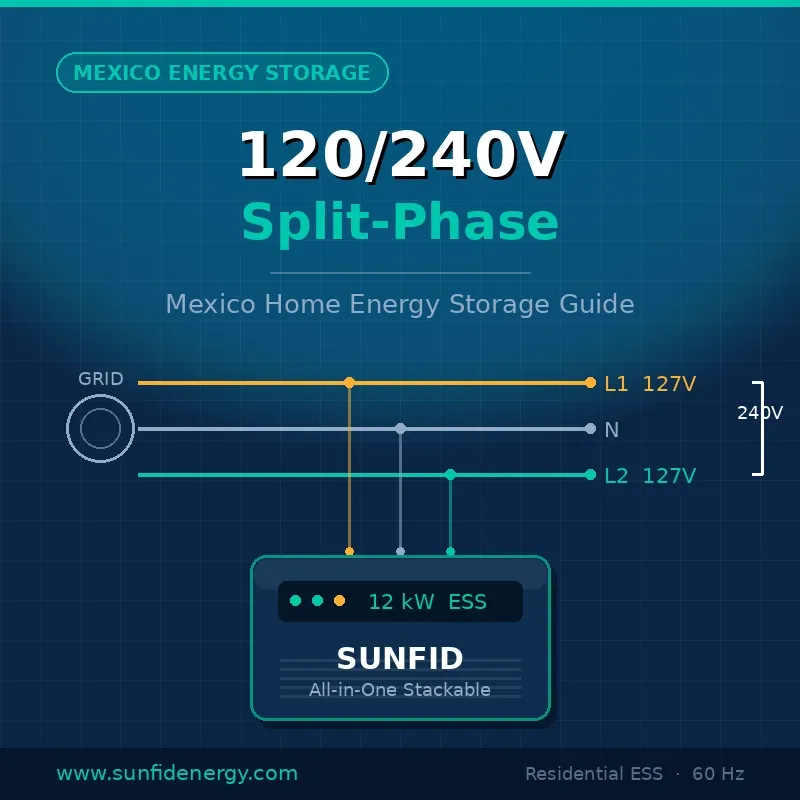
It consists of three wires:
- L1 — first phase
- L2 — second phase
- N — neutral
Between L1 and N is 120V; between L2 and N is also 120V; and between L1 and L2 is 240V. This structure lets a single system both power ordinary outlets (120V) and directly drive high-power equipment (240V, such as central air conditioning, electric water heaters, and water pumps).
So when specifying for a Mexican customer, you cannot just ask "127V or 220V" — you must first confirm which connection the site actually uses.
What Happens to Ordinary Single-Phase Inverters in Mexico
Because split-phase is a complete 240V system, using an ordinary single-phase inverter directly creates problems.
A typical mistake is to use a single-phase inverter connected only to L1 and N, or only to L2 and N.
There are three problems:
- It cannot cover 240V loads Equipment such as central air conditioning, electric water heaters, and water pumps requires the 240V between L1 and L2. A single-phase inverter cannot provide it, so the customer's high-power appliances remain dependent on the grid.
- It cannot handle mismatched phases A single-phase output inherently depends on one side's voltage. When the grid has a phase deviation, the system can't respond—it can only accept it passively.
- It lacks voltage-abnormality protection Many ordinary inverters have no protection logic for voltage deviation. When the grid shows a clear mismatch between the two phases, the equipment either fails outright or runs long-term under abnormal voltage.
Selection Reference Table
Scenario | Supply Type | Recommended Solution |
Household, ordinary small loads | 127V single-phase | Single-phase energy storage system |
Household / small-to-medium commercial, with high-power equipment such as central AC or water heaters | 120/240V split-phase | Split-phase output all-in-one storage system |
Residential, commercial | 220V three-phase | Three-phase energy storage system |
Industrial | 220V / 440V three-phase | C&I / utility-scale storage |
Key test: does the customer's home have 240V equipment? If it does (central AC, electric water heater, high-power water pump), a split-phase solution is mandatory — otherwise the system covers only half the electricity demand.
Our Solution: Native 120/240V Split-Phase Support
Sunfid's residential all-in-one storage series is designed natively for Mexico's grid:
- Native 120/240V split-phase output — full L1/L2/N support, one system covering both 120V outlets and 240V high-power equipment
- Wide voltage adaptation — a wide input voltage operating range, designed for the reality of grid voltage fluctuation
- Voltage-abnormality protection — protection logic against under-voltage and over-voltage, reducing the risk of equipment damage
- Customization by scenario — capacity, interfaces, communication protocols, enclosure, and certification can all be adjusted to project requirements
If the customer already has a suitable inverter, our wall-mounted battery system can be paired with it to form a complete home energy storage solution.
If you are specifying for a Mexican customer, or are unsure which supply type your project requires, you can:
- Visit our Residential ESS product page for full specifications
- Contact us directly with the customer's load list, and we will provide a selection recommendation.