Oct 12, 2026Buying Guides
Latin America energy storage market: voltage standards and certification by country
Voltages and certifications differ across Latin America. Country-by-country guide for storage in Mexico, Brazil, Chile, Colombia, Peru and Argentina.
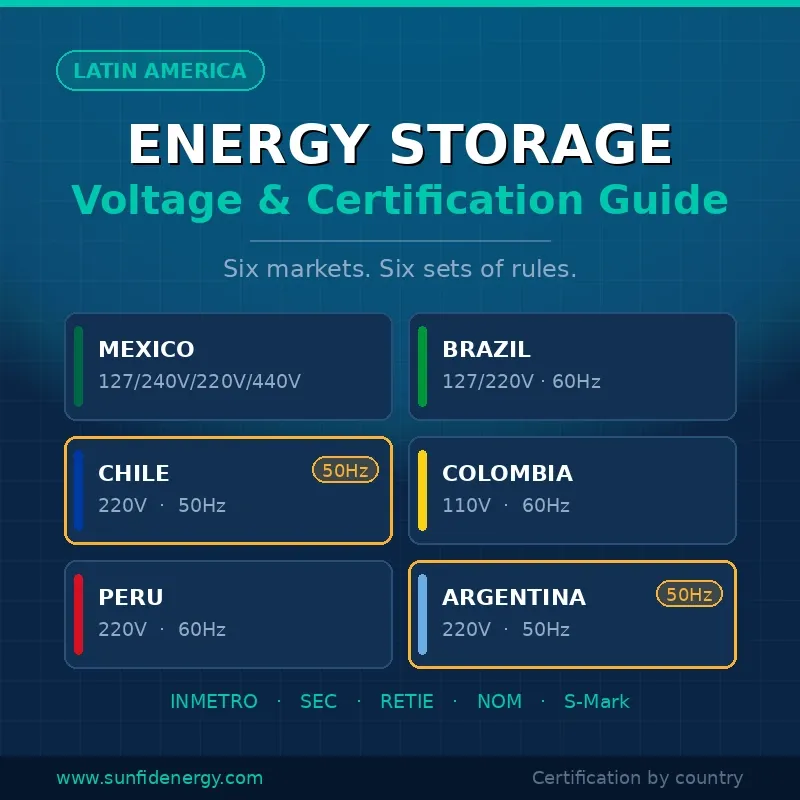
The voltages, frequencies, and certification bodies differ from one country to the next across Latin America, and most of these markets lack the kind of publicly documented entry guide you find in Europe. These differences determine whether your product can be used at all and whether it needs to be re-certified—which is the starting point for judging whether a market is worth entering and where to begin.
Voltage Is Not Uniform Across Latin America
Start with the table. Voltage and frequency come before certification — a product that cannot be used will not be rescued by a full set of certificates.
Country | Residential Single-
Phase | Industrial Three-
Phase | Frequency | Plug |
Mexico | 127V (120/240V
split-phase common
in homes) | 220V / 440V | 60Hz | Type A / B |
Brazil | 127V or 220V
(varies by region) | 220V / 380V | 60Hz | NBR 14136 |
Chile | 220V | 380V | 50Hz | Type C / L |
Colombia | 110V | 220V / 440V | 60Hz | Type A / B |
Peru | 220V | 380V | 60Hz | Type A / C |
Argentina | 220V | 380V | 50Hz | Type I |
Three pitfalls worth remembering:
Frequency is not 60Hz everywhere. Most of Latin America runs at 60Hz like the United States, but Argentina and Chile run at
50Hz. Send 60Hz equipment to these two countries and motor-driven loads will run at the wrong speed, overheat, and in
serious cases fail.
Colombia is 110V. It matches North America, not the 220V you might expect. Stock a product for "Latin America = 220V" and
none of it will work in Colombia.
Brazil is not even uniform inside one country. São Paulo is predominantly 127V, while Brasília, Manaus and Fortaleza are
predominantly 220V, and Rio de Janeiro mixes both. Products for Brazil must support a wide input range (100–240V); a single-
voltage design will not work.
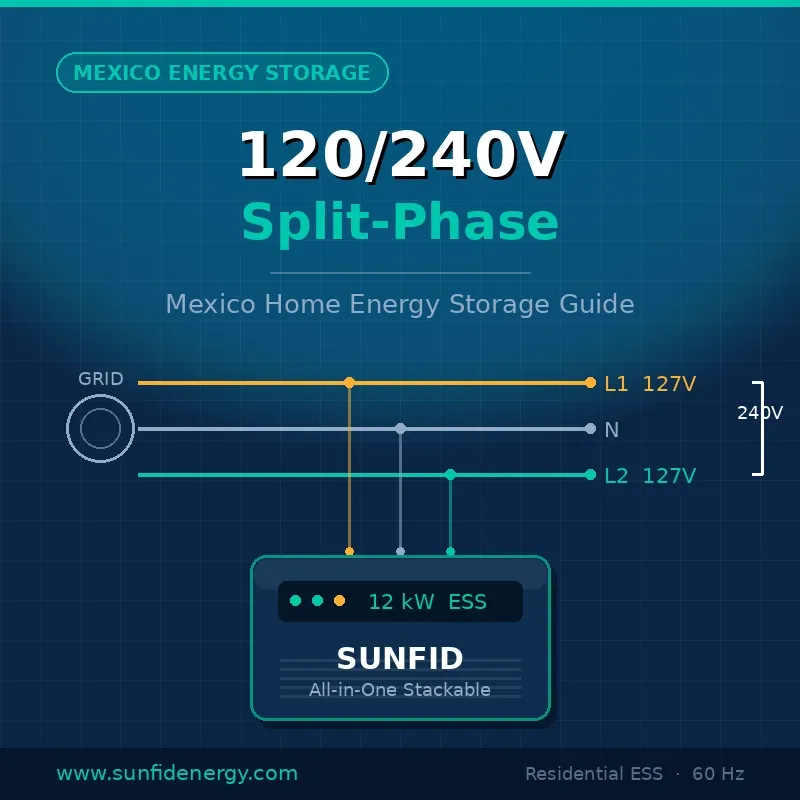
For comparison, Mexican homes widely use 120/240V split-phase wiring — the North American convention as it appears in
Latin America. For how split-phase works and what to look for when selecting equipment, see our article Mexico's Grid: Why
Home Storage Must Support 120/240V Split-Phase.
Certification Requirements by Country
Once voltage and frequency are settled, certification comes next. Each Latin American country runs its own system — there is
no single "Latin America certificate."
Mexico: NOM + CFE Interconnection
Administered by the Ministry of Economy and the Federal Electricity Commission (CFE), with standards coordinated by INN.
● Core standards: NOM-001-SEDE (electrical safety), NOM-003-SCFI (labeling and marking), NOM-019-ENER (grid interconnection safety for PV and storage)
● UL, ETL, CE and CB certifications are not accepted as a substitute; local Mexico-specific difference testing is required
● The certificate must be held by a Mexican importer or an entity with an RFC tax number — a Chinese factory cannot hold it directly
● Labels and manuals must be in Spanish
● Grid connection requires an interconnection application and a bidirectional meter request to CFE
For systems with storage, NOM-019 is more demanding: beyond interconnection safety, it assesses coordination between the BMS and the PCS, charge/discharge protection, and on-grid/off-grid switching.
Brazil: INMETRO (Highest Barrier, Largest Market)
The regulatory basis is Portaria 140/2022 , which sets the conformity assessment framework for PV generation, conversion and storage equipment; Portaria 515/2023 adds the AFCI requirement for inverters.
● Inverters: ABNT NBR 16149 (grid interface) + IEC 62109 (safety)
● Batteries: ABNT NBR 16767 (capacity, cycle life, self-discharge)
● EMC: CISPR 11
● Certification requires an OCP to issue the certificate, testing at an RBLE-accredited laboratory, and a factory audit; the product carries the INMETRO mark
● A Brazilian legal representative is mandatory, and test documents must be in Portuguese
● Typical timeline is 4–6 months; annual post-certification surveillance, re-testing every 36 months, and full re-certification
every 6 years
AFCI is now mandatory. Under INMETRO rules, from 1 December 2024, new PV inverters manufactured or imported into Brazil must have built-in AFCI (per the IEC 63027 standard). The threshold is grid-tied inverters with a DC voltage above 120V; models with an open-circuit voltage of 120V or below and a short-circuit current of 20A or below may be exempt if the control technology guarantees arc interruption under all operating conditions. There is no fixed cut-off date for selling existing non-AFCI stock, but fire inspections already require it — the absence of AFCI can block renewal of fire permits such as AVCB or CERCON.
Chile: SEC (Mandatory Local Certificate Holder)
● Core standards: IEC 62109-1/2 (safety), NTC 2050 (grid compatibility)
● Voltage 220V/50Hz, tolerance ±10% (198V–242V); requires wide-voltage, surge and ramp-down testing
● Grid-tied inverters must comply with IEC 62109-1/-2 and provide anti-islanding protection under IEC 62116
● SEC Instruction RGR No. 02/2024 further regulates the installation and authorization of grid-tied microinverters
● From 1 January 2026, inverters used in new TE-4 declarations must have AFCI protection (compliant with IEC 63027 or UL 1699B ); an external authorized AFCI can be used via the special-project route
● The SEC certificate must be held by a Chilean importer or local representative — a Chinese manufacturer cannot hold it directly
● Manuals and nameplates must be in Spanish
● Certificate validity is 3 years
Chile is a high-seismic zone, so fixed equipment must pass a 0.5g acceleration vibration test; products sold in coastal areas also require salt-spray testing.
Colombia: RETIE (Mandatory Local Testing)
Administered by the Ministry of Mines and Energy, RETIE applies to AC equipment from 25V to 1000V.
● Products must be tested at a Colombian ONAC-accredited laboratory; foreign companies must appoint a local agent to apply
● The grid standard is 110V/60Hz, and the product must fully match it
● Technical documents, manuals and nameplates must be in Spanish, and the RETIE mark must be at least 5mm high
● Copper conductors generally may not be replaced with aluminum; material flame resistance must reach UL94 V-0 or equivalent
● Two certification modes: batch certification (valid for a single shipment) and three-year certification (requires a factory audit)
In April 2026, new Colombian rules created a separate procurement category for energy storage, with power purchase agreements of up to 15 years.
Peru: Lowest Barrier
Residential 220V/60Hz. Certification is mandatory only for cables; other electrical products have no separate mandatory certification, though plugs must carry a European approval mark. It is one of the lowest-barrier markets in Latin America.
Argentina: S-Mark (Low Barrier, But 50Hz)
Under Resolution 92/1998 , products with an input voltage of 50 1000VAC require mandatory S-Mark certification.
● Standards are mainly IRAM, largely based on IEC
● An Argentine legal representative is mandatory; manuals and nameplates must be in Spanish
● Plugs must comply with IRAM 2073 (Class I) or IRAM 2063 (Class II)
● IRAM is a CB scheme member, so CB reports can be used directly for conversion
● Three modes: mark certification (requires factory audit and annual review), type approval, and batch certification
● Frequency is 220V/50Hz — the opposite of Brazil and Colombia
What Carries Over, and What Does Not
Test reports can be converted between countries; mandatory certification itself cannot. This is the point most often
misunderstood.
Can Be Reused | Cannot Be Reused |
IEC / CB test reports (IEC 62109, IEC 62619, etc.) | National mandatory certificates (INMETRO, SEC, RETIE,
NOM, S-Mark) |
Completed safety and EMC test data | Local agent and certificate-holder requirements |
Product technical files (schematics, BOM) | Spanish and Portuguese labels and manuals (must be
localized) |
From this comes one practical path: complete the full IEC / CB test suite first. It is the common foundation for all Latin
American certifications, so a single investment supports multi-country conversion. Brazil, Chile, Colombia, Mexico, and
Argentina all require a local certificate holder, so finding a local importer or agent early is unavoidable.
Note on data: The voltage standards, frequencies and certification requirements in this article are compiled from publicly
available national regulator rules and industry practice. Regulations change; before entering a market, please verify
against the target country's latest official requirements and the version confirmed by your local agent.